Request a free estimate



Showing the single result
A laboratory balance table is a dedicated workstation designed to isolate sensitive weighing instruments from vibration. Analytical balances, microbalances, and other precision instruments produce inaccurate readings when the surface beneath them transmits movement from foot traffic, nearby equipment, or building systems. A purpose-built balance table addresses this by decoupling the work surface from its base, reducing the vibration that reaches the instrument.
What to Look for in a Laboratory Balance Table
The most important functional characteristic is vibration isolation. This is typically achieved through dampening pads or isolation mounts inserted between the work surface and the base, which absorb movement before it reaches the instrument above. Surface material also matters: dense, stable tops such as granite or similarly rigid materials provide a more consistent platform for precision work than standard phenolic or laminate surfaces.
Footprint and height are practical considerations as well. Balance tables are generally compact, since they serve a single dedicated function rather than acting as general bench space. Standing height is standard for most applications. The table should be freestanding so it can be positioned wherever vibration sources are lowest in your specific lab layout.
CatLabPro Balance Tables
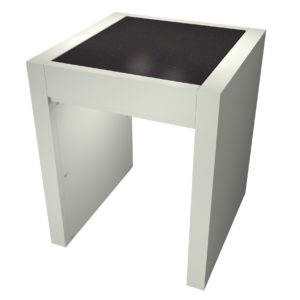
CatLabPro stocks laboratory balance tables built for precision instrument use in research, pharmaceutical, industrial, educational, and medical laboratory settings. The current lineup includes the AAVA30, a standing-height model measuring 30″W x 30″D x 36″H with a black granite top and a Glacier White powder-coated steel base. Vibration reduction pads are inserted between the top and legs to isolate the surface and enhance the damping effect.
As this category grows, additional configurations may be available. Contact CatLabPro to ask about current stock and any options not yet listed online.
Placement Guidance
Balance tables perform best when positioned away from high-traffic corridors, HVAC vents, centrifuges, and other equipment that generates continuous movement. Placing the table on a solid floor rather than a raised platform further supports measurement stability. Because these tables are freestanding, placement can be adjusted to wherever vibration interference is minimized in your space.
To discuss which balance table fits your application or to request a free estimate, contact the CatLabPro team directly.
FAQs
What makes a balance table different from a standard lab table?
A balance table is specifically engineered to reduce vibration transfer to the work surface. This is typically achieved through isolation pads or mounts between the top and the base structure. A standard lab table does not include this mechanism and is not suitable for applications where surface stability directly affects measurement accuracy.
What surface materials are used on laboratory balance tables?
Dense, dimensionally stable materials are preferred for balance table tops. CatLabPro’s current balance table features a black granite top, which provides the rigidity and mass needed to support accurate readings from precision instruments.
What instruments are typically used on a balance table?
Balance tables are most commonly used with analytical balances, microbalances, and other precision weighing instruments. Any instrument where minor surface movement could affect output accuracy can benefit from a dedicated isolation table.
How do I choose the right size balance table for my lab?
Consider the footprint of the instrument you are housing plus any immediate accessories such as a draft shield, calibration weights, or a printer. Most balance tables are compact by design. CatLabPro can help you confirm sizing based on your specific equipment and available floor space.
Where should a balance table be positioned in a lab?
Place the table as far as practical from vibration sources including HVAC equipment, centrifuges, foot traffic routes, and building mechanical systems. A solid floor location is preferable to a raised or suspended platform. The goal is to minimize the environmental vibration the table’s isolation system has to manage.
Can CatLabPro help me select the right balance table for my application?
Yes. Contact CatLabPro to consult with the team about your instrument requirements, lab environment, and available configurations. If you have needs beyond what is currently listed, it is worth reaching out to ask about options.
A laboratory balance table is a dedicated workstation designed to isolate sensitive weighing instruments from vibration. Analytical balances, microbalances, and other precision instruments produce inaccurate readings when the surface beneath them transmits movement from foot traffic, nearby equipment, or building systems. A purpose-built balance table addresses this by decoupling the work surface from its base, reducing the vibration that reaches the instrument.
What to Look for in a Laboratory Balance Table
The most important functional characteristic is vibration isolation. This is typically achieved through dampening pads or isolation mounts inserted between the work surface and the base, which absorb movement before it reaches the instrument above. Surface material also matters: dense, stable tops such as granite or similarly rigid materials provide a more consistent platform for precision work than standard phenolic or laminate surfaces.
Footprint and height are practical considerations as well. Balance tables are generally compact, since they serve a single dedicated function rather than acting as general bench space. Standing height is standard for most applications. The table should be freestanding so it can be positioned wherever vibration sources are lowest in your specific lab layout.
CatLabPro Balance Tables
CatLabPro stocks laboratory balance tables built for precision instrument use in research, pharmaceutical, industrial, educational, and medical laboratory settings. The current lineup includes the AAVA30, a standing-height model measuring 30"W x 30"D x 36"H with a black granite top and a Glacier White powder-coated steel base. Vibration reduction pads are inserted between the top and legs to isolate the surface and enhance the damping effect.
As this category grows, additional configurations may be available. Contact CatLabPro to ask about current stock and any options not yet listed online.
Placement Guidance
Balance tables perform best when positioned away from high-traffic corridors, HVAC vents, centrifuges, and other equipment that generates continuous movement. Placing the table on a solid floor rather than a raised platform further supports measurement stability. Because these tables are freestanding, placement can be adjusted to wherever vibration interference is minimized in your space.
To discuss which balance table fits your application or to request a free estimate, contact the CatLabPro team directly.
FAQs
What makes a balance table different from a standard lab table?
A balance table is specifically engineered to reduce vibration transfer to the work surface. This is typically achieved through isolation pads or mounts between the top and the base structure. A standard lab table does not include this mechanism and is not suitable for applications where surface stability directly affects measurement accuracy.
What surface materials are used on laboratory balance tables?
Dense, dimensionally stable materials are preferred for balance table tops. CatLabPro's current balance table features a black granite top, which provides the rigidity and mass needed to support accurate readings from precision instruments.
What instruments are typically used on a balance table?
Balance tables are most commonly used with analytical balances, microbalances, and other precision weighing instruments. Any instrument where minor surface movement could affect output accuracy can benefit from a dedicated isolation table.
How do I choose the right size balance table for my lab?
Consider the footprint of the instrument you are housing plus any immediate accessories such as a draft shield, calibration weights, or a printer. Most balance tables are compact by design. CatLabPro can help you confirm sizing based on your specific equipment and available floor space.
Where should a balance table be positioned in a lab?
Place the table as far as practical from vibration sources including HVAC equipment, centrifuges, foot traffic routes, and building mechanical systems. A solid floor location is preferable to a raised or suspended platform. The goal is to minimize the environmental vibration the table's isolation system has to manage.
Can CatLabPro help me select the right balance table for my application?
Yes. Contact CatLabPro to consult with the team about your instrument requirements, lab environment, and available configurations. If you have needs beyond what is currently listed, it is worth reaching out to ask about options.